 Published
The Burning Mountain
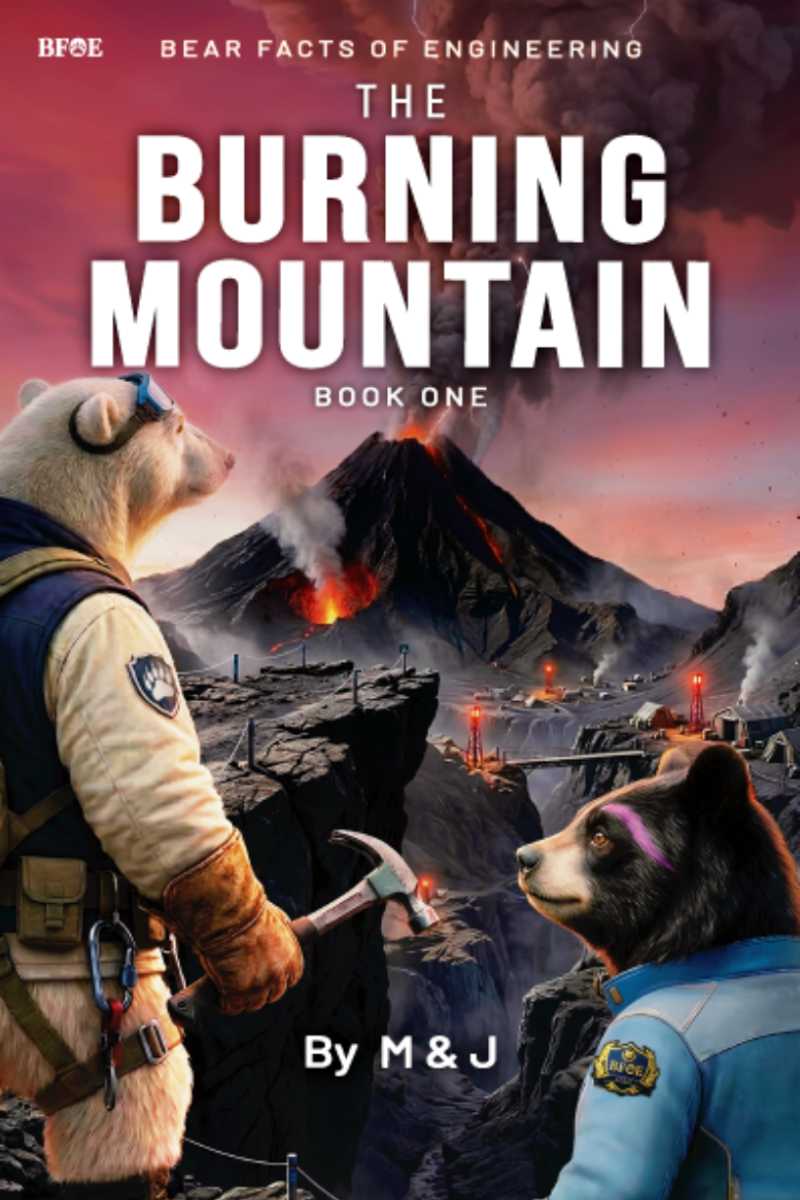
The Burning Mountain is waking. And it will not wait.
When the ground twitches beneath Monty's boots on the survey ledge, he knows the quiet is over. The Burning Mountain, silent for generations, is stirring, and a whole village lies in its path.
No superheroes are coming. Instead there's a team: bear engineers with instruments, plans, and each other. As ash falls, bridges fail and the lake begins to boil, Lina listens to what the mountain is saying, Gertie plans for survival, and Axel flies the run no one else can.
You can't stop a volcano. But you can be ready for it.
Parents and teachers will recognise the heartbeat under the adventure: courage is useful, but knowledge under pressure is what gets everyone home. Readers aged 8 to 12 get the rush of a disaster story that still respects cause and effect. Every choice has weight, every tool has a reason, and the line that stays when the ash clears is the series promise itself: engineering is the superpower.
Frightening things happen in this story. Nobody faces them alone, and nobody panics. Children finish it wanting to build something.
More than a story. Sixteen chapters of adventure, then the book keeps giving: The Real Burning Mountain shows readers the true events behind the fiction, The STEM Behind the Story unpacks the engineering the bears used, and the BEAR Engineering Challenge invites your child to build something of their own. Every technical term links to the free BFOE Glossary on this site.
Chapter 1 - When the Mountain Roared
On the morning the mountain really woke up, Monty was teaching cubs how not to panic.
He considered this a very useful lesson.
Panic, in Monty’s experience, had ruined more good thinking than bad weather and badly made tools combined. Panic made paws slip, eyes miss details, and perfectly sensible creatures forget where their feet were.
So when he took young visitors onto the lower survey ledges of the Burning Mountain, he always began with the same rule -
“Look first, then think, then move,” he told them. “In that order. Anyone doing this backward will spend the rest of the day carrying sample buckets!”
The cubs, who had clearly arrived hoping for more excitement than collecting rocks, just looked at him solemnly, already full of questions they hadn’t figured out how to ask yet.
They were a mixed little group from the valley village below the mountain - two bear cub sisters with matching ear ribbons, a fox with sharp eyes and dusty paws, a badger who was cuddling the measuring rods, a rabbit who bounced while standing still, and a young goat who constantly stood too close to ledges.
Monty approved of none of that.
The lower survey ledge sat beneath the vast shoulder of the Burning Mountain, high enough for the air to taste of stone and cold, low enough that the path stayed safe as long as you didn’t do anything stupid. Above them, the great cone rose in black and rust-red bands, scarred by old flows and broken rock ridges. Wisps of vapor drifted from vents near the summit, thin as breath on a frosty morning.
To the cubs, it looked exciting.
To Monty, it looked quiet.
Quiet was not the same as harmless. Quiet just meant it hadn’t started yet.
He had brought teaching crates up from the village that morning: a vent gauge, a thermal wand, a folded danger map, and a portable core drill that he had already caught three cubs trying to switch on when they thought he wasn’t looking.
“Today,” he said, unrolling the danger map across a flat stone, “we are learning why engineers study mountains - before the mountain does something nobody packed for.”
The rabbit kit immediately raised a paw. “What kind of something?”
“The kind where rocks fly sideways and the ground gets extremely hot extremely fast.”
The cub’s eyes went wide. “Has that happened to you?”
“Twice,” said Monty. “The second time I lost a very good sandwich.”
That got the laugh he wanted. Small. Enough to warm the group without letting them forget where they were.
He pointed across the map. “This mountain has old vent lines here and here, old flow paths there, and a long history of surprising folks who stopped paying attention.”
The fox pup leaned in. “Is it going to surprise us?” Monty looked up at the real mountain, then back at the map. “Not if we do our job properly. That’s what engineers are for.”
He began the tour after that.
They learned how vents released gas, how temperature could be read across different rock types, and how old lava hardened in layers that told stories if you knew how to look. He showed them the bright-striped warning posts along the lower path and explained why they had been placed at exactly measured intervals.
“So even in bad weather,” he said, tapping the nearest post with one gloved claw, “you know where safety still lives.”
The young badger touched the post carefully, like it mattered. “So the posts do the remembering even when others can’t.”
Monty paused. That was pretty good.
“Yes,” he said. “Sometimes they do.”
At the final stop before lunch, he led them to a broad rock shelf where they could clearly see the summit vents. The mountain sent up a lazy ribbon of steam that twisted sideways in the wind. Nothing alarming. Nothing urgent. But when Monty planted the vent gauge and waited, the needle quivered farther than he liked before settling back.
He frowned.
The young goat noticed. “What is it?”
“Probably nothing important,” Monty said.
This was not exactly a lie. But Monty’s version of probably nothing important still included quite a lot of things most creatures would rather not meet before dinner.
He checked the thermal wand against a nearby rock seam. Slightly elevated. The summit vapor thickened for one long breath, then thinned again.
The mountain was quiet. But it was no longer lazily quiet. Now it felt like it was holding its breath.
“We are heading down a little earlier than planned,” Monty said.
Instant disappointment, as predictable as gravity.
“But we haven’t had the crater story yet!” protested one of the bear cub sisters.
“You may have it while walking,” said Monty. “A far safer arrangement.”
There were groans. There were sighs. There was one dramatic collapse against a rock from the rabbit, who clearly believed education should only happen while stationary and preferably near snacks.
Monty ignored all of it.
He had just begun gathering the instruments when the ledge beneath his boots gave the smallest, ugliest twitch.
Not a landslip. Not a loose stone.
A pulse.
It passed so quickly that two of the cubs missed it entirely. The others did not - cubs often felt things like that before grown-ups were willing to say so.
The fox cub looked up sharply. “Did it just do that?”
Monty’s answer came fast. “Yes. We’re moving now.”
That tone changed everything.
The cubs did not understand numbers, or vent models or what different tremor waves meant through old volcanic rock. They did not need to. They knew adult voices. They knew when one stopped being patient and became the kind of voice you do not argue with.
They lined up. Almost beautifully.
Monty gave instructions while packing at the speed of someone who had done this too many times. “Stay between the posts. No overtaking. No looking back while walking. If you fall, you call. If someone else falls, you do not stop in the path unless I tell you. Understood?”
A chorus of yeses. Smaller voices now.
Good.
He took the rabbit and goat into the middle of the line where they could do least creative damage, and began leading them down the marked path.
The second tremor came halfway to the lower bend.
It rolled through the mountain with enough force to make the warning posts hum. Pebbles skittered from the slope above. A crack snapped somewhere out of sight. One cub cried out. Another froze.
Monty turned at once. “Look first. Then think, then move. Together.”
It worked. Because rules learned in calm are worth twice as much in fear.
The steam ribbon above the summit had thickened into a crooked white plume - not enormous, not yet, but no longer lazy. The air smelled sharper, with that mineral sting Monty had learned to distrust.
He keyed his comm band. Static hissed.
“—Monty? Reading—”
“Lower survey group descending,” he said. “Possible activity increase. I want village watch raised.”
The path curved around a rib of dark basalt and entered the narrowest section, where a low wall guarded one side, and the drop fell toward scrub and boulder fields below. Monty hated this section on a calm day. He hated it personally on a waking mountain.
He sent the cubs one by one past the tightest turn.
The goat chose that exact moment to look up and say, with the clear ringing voice of someone announcing the weather at a picnic, “It’s glowing.”
Monty looked.
At the summit vent, deep inside the throat of steam, a dull orange pulse blinked once. Then again.
The mountain inhaled.
And roared.
The sound hit the slope like a hammer the size of the sky. Steam exploded upward. Ash punched after it in a black-gray burst. A spray of glowing stones arced from the vent mouth in a trail of sparks.
The cubs screamed.
Monty did not waste one heartbeat wishing they would not. This was a mountain announcing itself. Anyone with sense should have screamed at least a little.
“Down!” he thundered.
He threw himself over the rabbit and goat as grit and hot dust rattled across the path. The bear sisters crouched against the wall exactly as instructed, one reaching for the other’s paw without looking. The badger flattened under the low rail, both arms wrapped around the measuring rods he had carried all morning, holding them the way a smaller cub holds a blanket. The fox clung to the warning post with both paws and shut his eyes so tightly his face wrinkled.
When the first burst eased, Monty was already moving.
“On your feet!”
The cubs staggered up - coughing, ash-dusted, terrified.
Alive.
Always that first.
He counted them in one sweep. Six. Still six.
“Now we run,” he said.
He drove the group downslope in urgent bursts from post to post, using the wall where it existed and the inner rock line where it did not. Hot grit stung the backs of their ears. The air tasted of burning stone and something sharper underneath, something that made every breath feel borrowed.
At the lower ledge junction, the badger stumbled. The sample bucket he had insisted on carrying bounced toward the drop. He lunged after it.
Monty caught the back of his harness one claw-width before the child followed the bucket into open air.
“The bucket,” Monty said, hauling him back, “has made its choices.”
The badger’s chin was shaking. His eyes were enormous and wet and trying very hard not to be.
Monty rested one paw on his head, just for a moment. “You’re all right,” he said quietly. “Stay with me.”
Then he pushed him gently but firmly into the center of the line.
Below them, figures were running up from the base station - adult figures in bright field hoods. Good.
“Take the cubs,” Monty told the first to reach them. “All six. Straight to lower shelter protocol. Count twice.”
Only when the last cub was safely downhill did Monty allow himself one second to turn and look up.
The Burning Mountain had changed.
The summit plume leaned hard east under the wind. Fresh ash rolled down one inner gully in a dark, spilling wave. The old vents along the shoulder had begun steaming where they had not steamed this morning. The cone no longer looked like a mountain that might go back to sleep.
Now it looked as though every part of it was trying to open at once.
Monty touched the comm band again. The line cleared. Barely.
“Operations yard,” he said, eyes fixed on the smoking slope. “This is Monty. Raise full mountain watch. Repeat, raise full mountain watch. This is not a drill. The Burning Mountain is waking for real.”
He heard voices, questions, and one shouted order in the background.
Then above him, the summit flashed again. Deep inside the roar, a second lower sound came - not from the vent, but from the rock itself. A cracking growl below the rim, as if the mountain had more than one mouth and was testing another.
Monty looked at the warning posts, the path, the village below, the smoke climbing into the sky, and knew with complete certainty that this was only the beginning.
Then he turned and ran downhill toward the valley, where the others would need him before the mountain made its next decision.
Chapter 2 - Lina Hears the Mountain Speak
By the time Lina reached the operations yard, the sky above the Burning Mountain looked like a drawing someone had made with charcoal in anger.
Ash streamed east in a long dark smear. The summit plume rose in pulsing bursts rather than a single steady column. Steady columns at least behaved like themselves. Pulsing plumes meant the mountain was changing its mind.
Lina’s paw was already feeling for the field slate on her hip before she had finished looking at the sky.
That was how she answered fear. She measured it.
It did not always work. But it worked better than standing still.
The operations yard sat on a broad terrace above the valley, part field station, part workshop, part emergency assembly point. Storage sheds had been thrown open, and creatures hurried between them carrying cable, mask filters, and tools. Everything tasted of ash and rising panic.
At the center of everything stood Gertie.
She was a grizzly bear. Not the biggest grizzly Lina had ever seen, but the loudest when it mattered, the most organized always, and the most impossible to argue with under any known conditions. Gertie ran the operations yard the way some creatures ran armies, except with better labeling and considerably less tolerance for nonsense.
“Not that crate, the sealed one!” Gertie’s voice traveled across the whole yard without effort. “If those straps are acid-scored they go to inspection! And if anyone says ‘where should this go’ without reading the enormous label I personally attached to it, I may begin assigning educational sweeping duties!”
Creatures moved faster.
Lina approved.
She crossed the yard carrying two hard cases and a thermal field slate tucked under her arm. Her free paw brushed the surface of a supply crate as she passed, testing it, reading the material, the way her father had taught her to read any surface at first touch. Two fingers, light pressure, let the texture speak. It was one of the first things he had shown her, back when she could barely reach the workbench. She did it now without thinking.
She was fourteen. Most creatures meeting her for the first time did not believe that. She moved with a steadiness that made people guess older, and she spoke about chemistry with a precision that made them guess much older. Two college degrees before her fifteenth birthday. The youngest materials specialist the BEAR team had ever accepted.
But she was also fourteen. And fourteen meant that her stomach still clenched when she walked into a crisis yard full of adults who had been doing this since before she was born. Fourteen meant that when she heard the mountain boom from three valleys away, her first thought was scientific, her second thought was the one she would never admit to anyone: what if I get this wrong and someone gets hurt because of me?
She was smaller than Gertie. Narrower than Monty. Her dark coat was mostly hidden beneath a field jacket built to handle chemicals, heat, and bad weather. A speckle of magenta-lilac marked the fur above her left eye, the only flash of color on her. Her eyes missed very little. They never had. Even as a cub, she had spotted things in materials that grown-up engineers walked straight past.
Spotting was the easy part. Knowing what to do about it was harder.
“Lina,” said Gertie.
“Gertie,” Lina responded.
“Tell me you brought good news.”
“I brought equipment.”
“Fine. Sometimes that is the same thing.”
It was not, and they both knew it. But Gertie had a way of moving forward that made the distinction feel unhelpful.
Monty came in from the lower access lane with ash dusting his shoulders. His expression was controlled, but controlled was not the same as relaxed.
“You got the children down?” Lina asked.
“All six. Shaken, coughing, proud of surviving. The usual combination.”
He said it in eight words. Lina had noticed this about Monty. Other adults filled silences with reassurance. Monty compressed. If his sentence was short, the situation was serious. If it was very short, do not ask the next question unless you are ready for the answer.
Monty stopped beside the central table. “The summit vent flashed before the first major burst. Then a secondary crack sound under the rim. Something opening.”
“Gas smell?” Lina asked.
“Sharper. Sulfur... and something mineral.”
“Heat on the lower path?”
“Small. More than I liked. Less than I could prove.”
That answer almost made her smile. Monty never exaggerated just to sound useful. He was one of the first on the team to speak to her as an equal, back when she had arrived only weeks ago with two degrees and a sample case bigger than her confidence. She would never forget that.
He glanced at her now. Not worried. Not protective. Checking. The way a good engineer checks a load-bearing wall.
She was holding. Probably.
Gertie thumped a marker onto the map. “Report admiration later.” She looked between them. “One bad burst, or a very rude week?”
Lina was already unclipping the first hard case. Inside lay three sensor heads packed in foam, sample strips in sealed sleeves, two coiled gas lines, and a relay puck no bigger than a cookie but twenty times more useful.
“I can’t tell you what it’s going to do next week.” She lined the sensor heads up on the bench. “I can barely tell you what it’s doing right now.”
She looked up. Gertie’s eyebrow had risen exactly one degree. That was Gertie’s way of saying: and?
“But I can start asking it better questions.”
“Then ask,” said Gertie. “Quickly!”
Lina set to work. The yard roofline, the slope posts, and the upper shelf became a quick network of sensors. One tracked ash density. Another measured heat moving across the shoulder below the summit. The third watched the gas coming off the plume whenever the wind blew it close enough to catch.
Around her, the yard hummed with activity. Other bears were working on drones, tying relay feeds into signal boards, and moving transport vehicles into readiness positions on the west side. Lina did not know all their names yet. She had been with the team for only weeks. But she could see how they moved, and it reassured her: these folks had done this before.
Her paws, meanwhile, had their own argument with the volcano. The sensor heads needed to be calibrated in conditions for which they were not designed. Ash kept filming the contacts. The thermal strip reader gave her three contradictory results before she found a clean angle. Her fingers moved fast, adjusting, testing, wiping grit from a contact pin with her thumb.
She wished her father were here. Not because she needed help. Because he would have known which of the three contradictory readings to trust first, and it would have taken him two seconds instead of the twenty she had just spent.
The first gas readings came back worse than she hoped.
Too much sulfur. Possible gas pockets are building near the lower drains. Steam rising and falling too sharply for a simple summit burst. And underneath it all, a pattern in the heat readings that made the fur along her arms prickle under the field jacket.
Monty noticed. He always noticed.
“What is it?”
Lina tapped the slate. “The shoulder below the summit is heating in stripes. Not one area. Several.”
She paused. She wanted to say something precise, something that sounded like a proper analysis. What came out was closer to what she actually felt.
“The heat is looking for weak spots. And it’s finding them.”
Monty said nothing for a moment. That was worse than a question.
Across the yard, a drone launched into the darkening sky. The operator fought the ash for altitude. The feed on the yard board flickered, crackled, and for one clear second showed the upper slope through the murk: black ridges, white steam bursts, and one ugly orange flicker well below the main vent.
The feed died. Came back. Died again.
“That was not summit height,” Lina said quietly.
Gertie had crossed the yard in four strides. “Say that again.”
“The glow. It wasn’t from the main crater. It was lower. On the shoulder.”
Monty straightened. Gertie looked at the frozen frame on the board, then at the map, then at Lina.
The next clear image came just before dusk, when the drone held stable long enough to skim across the upper shoulder and into a hollow below the summit ridge. The video wavered, but the image that came back was enough.
A crack line across the shoulder. Steam is venting from it in jerks. And beneath the steam, at intervals, a pulsing orange seam.
Not the main crater. Something else. Something beginning.
The feed ended entirely after that. But it had told them what it needed to tell.
Lina went still. Her brain had found something and her mouth had not caught up. She did what she always did when that happened. She pressed one paw flat against the map table. Something solid. Something she understood.
Then she stepped closer to the frozen image. Then to the map. Then back to her thermal lines.
“This is not only a summit eruption,” she said.
“You’re sure?” Monty’s voice was low.
“No.”
Monty just waited.
“I’m sure things are changing faster than anyone expected. If that glow means heat is moving under the shoulder, then the mountain isn’t just erupting from the top.” She swallowed. “It’s trying to find other ways out.”
She looked at Monty. Then at Gertie. Two adults who had survived emergencies she had only read about.
“We need to warn the valley shelters,” she said. “Now.”
Monty held her glance for one second. Then he turned to Gertie.
Gertie did not ask whether Lina was old enough to be trusted with this kind of call. She had settled that question in the first week. Instead, she asked the only question that mattered.
“How much time?”
“I don’t know,” said Lina.
The words cost her. She could feel her voice wanting to add something, a qualification, a range, a maybe. Something that sounded more like a real scientist and less like a fourteen-year-old standing in an ash yard saying the three worst words in engineering.
She said nothing else.
Gertie nodded once. “Then we assume not enough.” She turned toward the yard. “Signal team! Change the lower village watch pattern. Amber standby. Shelters notified by the hour.”
Orders flew. Bears moved. The yard shifted from busy to purposeful in a way that Lina could feel in the air.
Monty stayed beside the map. His fingers traced the line from the summit to the shoulder crack, then down toward the valley. He was doing what Monty always did: seeing the consequences before they arrived.
Lina watched him and understood something she had not quite grasped before. He was not reading the mountain. He was reading what came after.
Ash fell more thickly across the yard. Beyond the terrace edge, the village lanterns flickered to life one by one as the first uneasy evening settled under the plume.
Gertie stood beside the map with a mug that she placed in front of Lina without comment. Hot. Sweet. Made fast, carried straight, set down like an instruction.
“Drink that,” Gertie said. “Then tell me everything else your instruments are whispering.”
Lina wrapped both paws around the mug. The warmth helped more than she expected.
“The first eruption was not the whole disaster,” she said. “It was the warning.”
Gertie looked at Monty. Monty looked at the mountain.
Nobody disagreed.